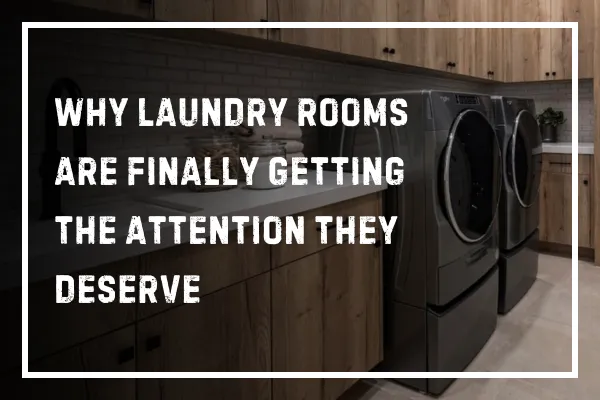
Why Laundry Rooms Are Finally Getting the Attention They Deserve
For decades, the laundry room was treated like the utility closet of residential design. Give it a washer, a dryer, one wire shelf, and whatever square footage nobody else wanted. If there was enough room to turn around without hitting the ironing board, congratulations. Luxury.
That thinking is changing. Homeowners are starting to treat laundry rooms less like leftover space and more like what they actually are: one of the hardest-working rooms in the house. The goal isn't necessarily to make laundry glamorous. We haven't advanced that far as a civilization. It's to make a repetitive household chore faster, easier, and considerably less annoying.
1. Storage Is Becoming Part of the Design
The classic laundry room storage solution was a shelf above the washer and dryer holding detergent, paper towels, and approximately 14 things nobody remembers buying. Today's laundry rooms are being designed with actual storage in mind.
Upper cabinets, tall utility cabinets, drawers, shelving, and designated spaces for hampers can keep supplies organized without consuming the work surface. The best storage isn't simply about having more cabinets. It's about putting things where they're actually used. Detergent near the washer. Hampers where clothes get sorted. Cleaning supplies somewhere accessible without creating visual chaos.
2. Countertops Are Doing More of the Work
If you've ever tried folding a fitted sheet on top of a washing machine, you've experienced the consequences of poor space planning. Countertop space is increasingly becoming a priority in laundry room design, particularly when machines can be positioned beneath a continuous work surface.
A good counter creates space for folding, sorting, treating stains, and temporarily placing the mysterious collection of objects found inside everyone's pockets. In smaller rooms, even a modest work surface can dramatically improve functionality. The lesson is simple: utility rooms need work surfaces because actual work happens there.
3. The Utility Sink Is Making a Comeback
Utility sinks aren't new, but they make considerably more sense once the laundry room starts being viewed as a true workspace. A deep sink gives homeowners somewhere to hand-wash clothing, soak stained items, rinse muddy shoes, clean tools, or tackle jobs they would rather keep away from the kitchen sink.
Location matters, though. A sink that consumes every available inch of counter space can create as many problems as it solves. The best laundry rooms balance specialty features with everyday needs. A giant farmhouse sink might photograph beautifully, but a smaller utility sink with useful counter space beside it may work better 364 days of the year.
4. Laundry Rooms Are Becoming Multi-Purpose Spaces
Square footage is expensive. Homeowners increasingly want rooms to earn their keep, and the laundry room is a natural candidate for multiple jobs. Depending on its location, it might double as a mudroom, pet-care station, cleaning-supply center, overflow pantry, or household storage area.
This works best when each function has a designated place. Hooks near the entrance can handle jackets and bags. Built-in benches can provide seating and shoe storage. A pet station might contain food, supplies, or even a washing area. Multi-purpose doesn't have to mean overcrowded. Done well, it means one room solves several everyday problems.
5. Better Lighting and Finishes Are Finally Showing Up
Laundry rooms have traditionally received whatever lighting fixture and paint color were left over. That is strange when you consider how much time people spend inspecting stains, sorting colors, matching socks, and wondering how an entire fitted sheet managed to wrap itself around one pillowcase.
Better lighting makes the room easier to use. Durable flooring and washable finishes make it easier to maintain. Color, tile, hardware, and cabinetry can make it feel connected to the rest of the house instead of looking like a room the designer forgot. It doesn't need to be extravagant. It just shouldn't feel like punishment.
6. Layout Matters More Than Square Footage
A large laundry room with a bad layout is still a bad laundry room. Machines, counters, storage, doors, hampers, and walkways all compete for space. If those pieces aren't planned around how someone actually moves through the room, additional square footage won't solve much.
Smaller laundry rooms can work remarkably well when every inch has a purpose. Stacked machines can free up floor space. Wall-mounted drying racks can disappear when not in use. Cabinets can extend vertically instead of consuming more floor area. Before adding features, the better question is usually: what makes doing laundry unnecessarily difficult in this room?
The Bottom Line
Laundry rooms are finally getting attention because homeowners are becoming less interested in designing houses exclusively around the rooms guests see. A beautiful kitchen matters, but so does the room you use three times a week while holding a basket of towels and trying to open a door with your elbow.
That's the larger shift happening in home design. Function is becoming part of the luxury. Better storage, smarter layouts, durable finishes, useful work surfaces, and thoughtful details don't just make a laundry room prettier. They remove friction from an ordinary part of life. And when a room handles hundreds of loads of laundry every year, removing a little friction starts looking like a very good investment.
