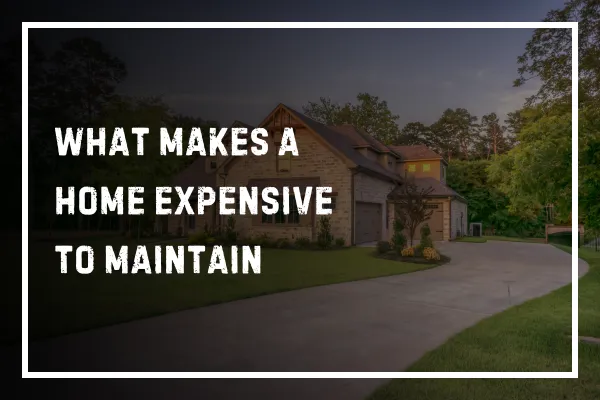
What Makes a Home Expensive to Maintain
The purchase price of a house gets all the attention. The maintenance price rarely does. But two similarly sized homes can have dramatically different long-term costs depending on how they were designed, built, and finished.
The expensive house isn't always the biggest one. Often, it's the one that makes routine maintenance complicated. Difficult access, too many transitions, elaborate materials, and design decisions that require specialized repairs can quietly turn an impressive home into a very expensive machine to keep running.
1. Complex Rooflines
Every valley, dormer, penetration, intersection, and change in roof direction adds architectural interest. It also adds another place where water has to be managed correctly. A simple roof has relatively few opportunities for something to go wrong. A complicated one can have dozens.
Complex roofs can also make routine work more difficult. Cleaning gutters, replacing roofing, repairing flashing, inspecting penetrations, and even accessing certain areas may require additional labor or specialized equipment. Complexity usually has a price, both when a home is built and when it needs attention later.
2. Hard-to-Reach Exterior Finishes
A beautiful exterior finish isn't particularly homeowner-friendly if maintaining it requires scaffolding or a lift. Tall walls, steep slopes, awkward roof intersections, and difficult-to-access trim can turn otherwise ordinary exterior maintenance into a much larger project.
This matters with painting, siding repairs, window maintenance, caulking, and cleaning. The material itself might not be expensive to maintain, but getting a person safely in front of it can be. Accessibility is one of those boring design considerations that becomes extremely interesting when the first maintenance bill arrives.
3. High-Maintenance Exterior Materials
Some materials are designed to weather with minimal attention. Others need periodic cleaning, sealing, staining, painting, or repair to continue looking and performing their best. There's nothing inherently wrong with choosing the latter, as long as you understand the relationship you're entering.
Climate makes that decision even more important. Moisture, sunlight, temperature swings, and vegetation can all affect how quickly exterior materials deteriorate. In places like the Pacific Northwest, materials and finishes that manage moisture well can reduce how much attention a home's exterior demands over time.
4. Too Many Joints and Transitions
Water loves transitions. Roof meets wall. Siding meets window. Deck meets house. Trim meets masonry. Every time one material ends and another begins, something has to manage the connection between them.
More transitions mean more flashing, sealants, joints, and details that can eventually require inspection or repair. Good construction can manage these areas extremely well, but simpler assemblies generally create fewer potential failure points. A complicated exterior gives water more opportunities to test the workmanship.
5. Excessive Tile and Grout
Tile is durable. Grout is where the relationship gets complicated. The more small tiles, decorative patterns, niches, corners, and tiled surfaces a home contains, the more grout lines there are to clean, monitor, and eventually repair.
This doesn't mean tile is a bad choice. It means material selection has consequences beyond appearance. Larger-format tile and thoughtful layouts can reduce the number of joints while still delivering the look homeowners want. Sometimes the easiest surface to maintain is simply the one with fewer seams.
6. Inaccessible Mechanical Components
Mechanical equipment eventually needs service. That's not pessimism. That's the business model of mechanical equipment. Water heaters, HVAC components, plumbing shutoffs, electrical panels, pumps, filters, and other systems all need to be inspected, maintained, repaired, or replaced at some point.
When they're buried behind finished surfaces or squeezed into spaces that are difficult to reach, a relatively simple repair can become a much bigger job. Good design doesn't just ask where equipment fits. It asks whether a technician can actually get to it ten years later without dismantling part of the house.
7. Elaborate Landscaping Against the House
Landscaping can make a house look dramatically better, but the relationship between plants and buildings deserves more attention than it gets. Dense vegetation against siding can trap moisture, restrict airflow, conceal deterioration, and make exterior inspections or maintenance difficult.
Trees and large shrubs can also create ongoing maintenance when branches overhang roofs, roots interfere with hardscaping, or irrigation repeatedly wets the structure. Great landscaping should complement the house without making the house harder to maintain.
8. Custom Features With No Easy Replacement
Custom details can make a home extraordinary. They can also create a problem when something eventually breaks. Unusual window sizes, proprietary fixtures, specialty hardware, one-off cabinetry components, and discontinued finishes can be difficult or expensive to replace.
The goal isn't to eliminate customization. It's to be strategic about where customization adds meaningful value. A feature that looks spectacular today should ideally have a reasonable repair or replacement path tomorrow. Otherwise, a small failure can become a surprisingly large project.
The Bottom Line
A low-maintenance home isn't necessarily a plain home. It's a home where complexity has been used deliberately. Materials suit the environment, important components remain accessible, water has clear paths away from the structure, and routine maintenance doesn't require an engineering degree and a 40-foot lift.
When choosing finishes, planning renovations, or evaluating a house, look beyond what something costs today. Ask what it will require five, ten, or twenty years from now. The cheapest home to maintain is often the one that makes future problems easy to see, easy to reach, and easy to fix.
