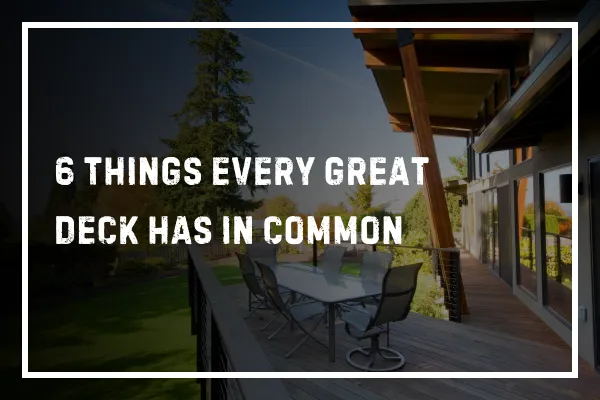
6 Things Every Great Deck Has in Common
Most decks fail for the same reason most gym memberships fail. The problem is not access. The problem is design.
Homeowners spend thousands of dollars building a deck, only to discover six months later that they rarely use it. The deck technically works. It meets code. It has railings. It has stairs. Yet somehow it becomes little more than a platform attached to the back of the house.
The difference between a deck that gets used every weekend and one that gets ignored has very little to do with furniture, decorations, or accessories. It comes down to how the space was designed and built from the beginning.
A great deck is not just a structure. It is an extension of the home.
1. Connection to the House Matters More Than Size
One of the biggest mistakes homeowners make is assuming a larger deck automatically creates a better outdoor space.
In reality, connection matters more than square footage.
A deck should feel like a natural continuation of the interior living space. When the transition between indoors and outdoors feels seamless, people naturally use the space more often. Wide access points, thoughtful stair placement, and a layout that flows directly from common living areas make a deck feel intentional rather than added on as an afterthought.
A poorly connected 500-square-foot deck will often see less use than a well-designed 250-square-foot deck.
2. Multiple Levels Create Purpose
Large, flat decks can feel surprisingly awkward.
Without structure, every activity competes for the same space. Dining, entertaining, relaxing, and circulation all happen in one oversized rectangle.
Well-designed decks create separation without creating barriers.
This can be accomplished through elevation changes, defined zones, built-in features, or strategic transitions between spaces. Even a modest change in height can make an outdoor area feel more organized and functional.
The result is a space that feels larger, more intentional, and easier to use.
3. Shade Is Not a Luxury
Many decks look fantastic in marketing photos taken at 9 a.m. on a mild spring day.
The problem appears at 3 p.m. in July.
Direct sunlight can make even the most beautiful deck uncomfortable during the exact hours homeowners want to be outside. Covered sections, pergolas, integrated roof structures, and strategic placement can dramatically increase the number of days a deck remains usable throughout the year.
In the Pacific Northwest, shade structures also provide protection from light rain, extending outdoor living well beyond the peak summer months.
The best decks are not designed for perfect weather. They are designed for real weather.
4. Built-In Features Change Everything
A deck should solve problems, not create them.
Built-in benches, privacy walls, planter structures, storage solutions, and integrated stair designs often outperform portable alternatives because they become part of the architecture rather than temporary additions.
These features create permanence and purpose. They make the space feel complete from day one instead of feeling like a project that still needs another trip to the home improvement store.
Good construction creates convenience. Great construction creates habits.
5. Privacy Is More Valuable Than Most Homeowners Realize
People do not spend time where they feel exposed.
One of the most overlooked factors in deck design is privacy. A deck may offer beautiful views of the backyard, but if it also provides direct views into neighboring windows, homeowners tend to use it less often.
Strategic screening, privacy walls, fencing integration, and thoughtful positioning can dramatically improve the experience of the space without making it feel closed off.
Privacy creates comfort. Comfort creates usage.
6. The Best Decks Feel Intentional
The decks that get used the most rarely have the biggest budgets.
Instead, they have something more valuable: purpose.
Every stair location, every transition, every covered section, and every built-in feature serves a specific function. The space feels connected to the home, comfortable throughout the seasons, and easy to use.
That is what separates a deck from an outdoor platform.
The Bottom Line
A deck becomes a space people actually use when it is designed around how they live, not simply around how much room is available. Connection to the home, purposeful layout, weather protection, built-in functionality, and privacy all play a bigger role than size alone.
The best outdoor spaces are not the ones that photograph well. They are the ones that become part of everyday life.
